
Lightweight Interpretable RGB-Guided Hyperspectral Super-Resolution under Real Cross-resolution Misalignment
1Mohamad Jouni, 1Aurélien Godet, 1, 2Mauro Dalla Mura
1Univ. Grenoble Alpes, CNRS, Grenoble INP, GIPSA-Lab, 38000 Grenoble, France
2Institut Universitaire de France (IUF), Paris, France
Our paper "Lightweight Interpretable RGB-Guided Hyperspectral Super-Resolution under Real Cross-resolution Misalignment" has been accepted to BMVC 2026! The work presents a lightweight confidence-aware approach for RGB-guided hyperspectral super-resolution under real cross-resolution misalignment.
Abstract
Compact snapshot hyperspectral cameras provide rich instantaneous spectral measurements for ground-level machine vision, but at lower spatial resolution than standard RGB cameras. RGB-guided hyperspectral super-resolution (HSR) addresses this limitation by transferring spatial detail from a high-resolution RGB guide to a low-resolution hyperspectral image (HSI). These dual-camera systems are typically in a horizontal rig geometry, requiring cross-camera image alignment due to different fields of view. However, residual misregistration can inject spurious high-frequency details. Existing learned unaligned-fusion methods are usually trained for a fixed spectral support and spatial scale factors and can be computationally demanding, limiting their flexibility across sensors.
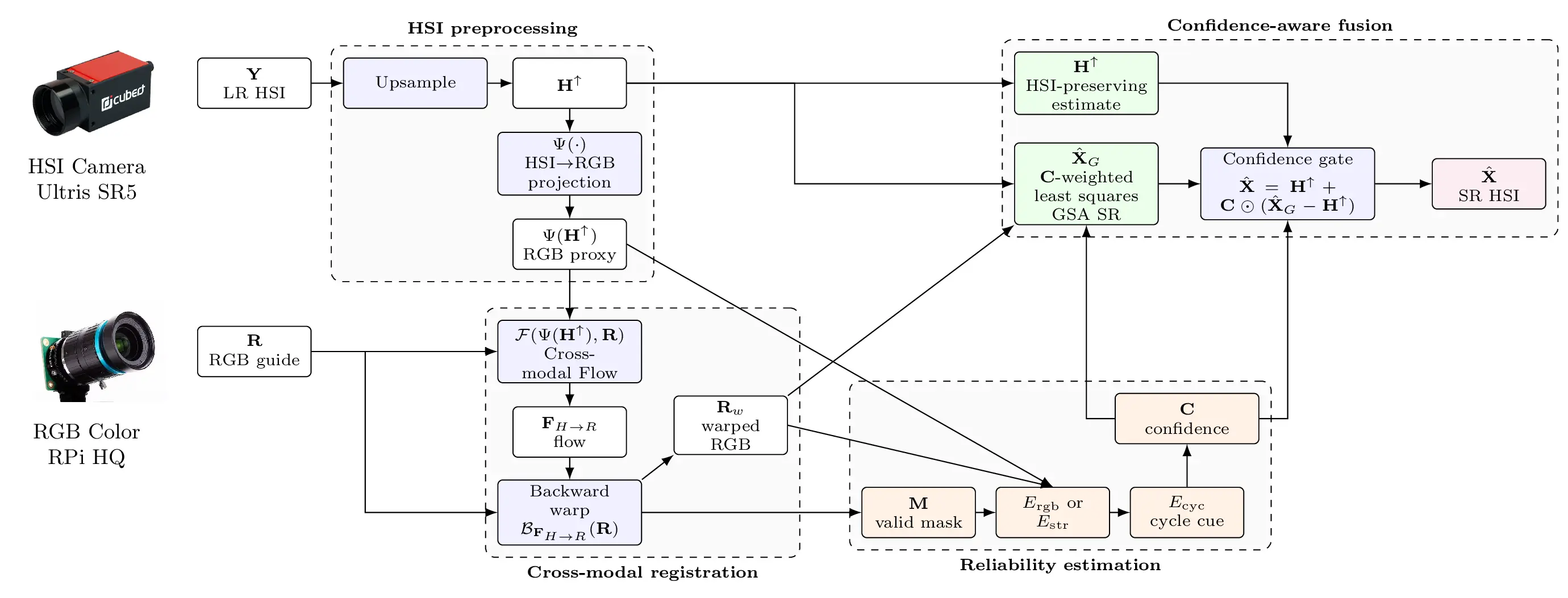
We propose a lightweight and interpretable RGB-guided HSR framework combining cross-modal flow alignment with model-based Gram-Schmidt orthogonalization fusion. The method first warps the RGB guide onto the HSI grid, then estimates an energy-based confidence weight map by measuring local alignment reliability. This map is then used both in a weighted least-squares spectral regression and in a gated fusion between the RGB-guided SR estimate and an HSI-preserving estimate. Unlike existing learned methods, the proposed framework has a low computational footprint and supports different VIS-NIR spectral supports and scale factors without retraining.
Experiments on the Real benchmark show that the proposed method improves reconstruction accuracy over learned fusion baselines while remaining substantially faster. On a 34-frame sequence acquired with our real RGB-HSI dual-camera setup, a reduced-resolution quantitative evaluation validates the method under genuine cross-sensor radiometric, noise, and geometric differences, while native-resolution qualitative results demonstrate deployment on the full 51-band visible-near-infrared acquisition beyond the 31-band setting of existing learned baselines.
Acknowledgements
This work was supported by the Institut Carnot Logiciels et Systèmes Intelligents (Carnot LSI) and by the French National Research Agency (ANR) under the France 2030 programme with reference ANR-23-IACL-0006. The computations were performed using the GRICAD infrastructure (GRANT CPER07_13 CIRA, ANR10 LABX56, ANR-10-EQPX-29-01).
Data acquisitions were carried out with the support of the Multi-camera Imaging Research and Acquisition (MIRA) Platform (https://mira-imaging.github.io/) of GIPSA-lab, which provided the camera setup and the acquisition and research resources used in this work. The MIRA Platform is developed with the financial support of the Institut Carnot Logiciels et Systèmes Intelligents (Carnot LSI).
The authors thank Dr. Amaury Negre for his contributions to the ROS-based acquisition software and to the acquisition of the Ultris-RPi sequence.