
SHARPnP: Self-Supervised and Plug-and-Play Hyperspectral Super-Resolution from Real Noisy Unaligned Camera Measurements
Mohamad Jouni, Brayan Monroy, Jorge Bacca, Mauro Dalla Mura
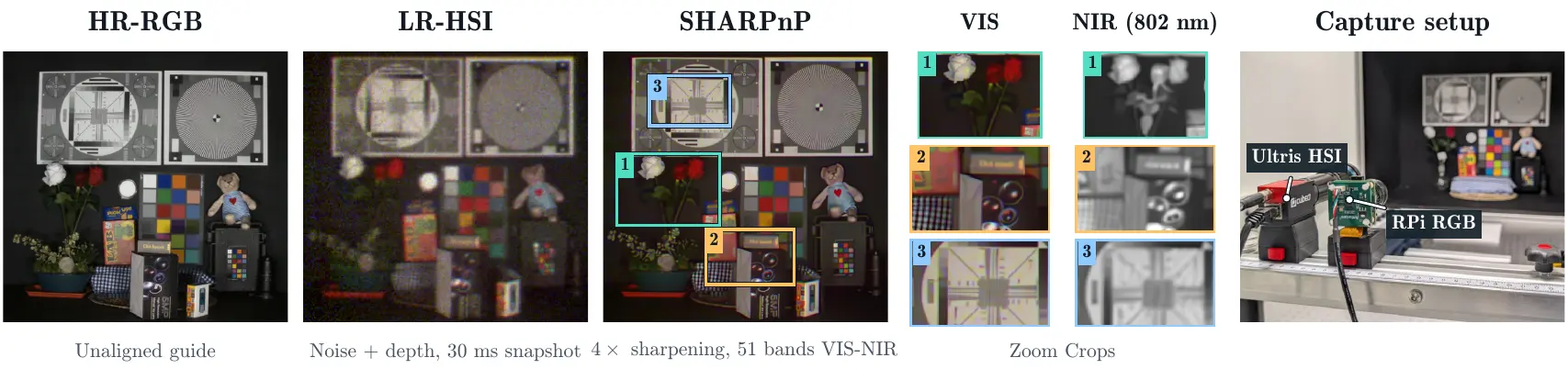
Our preprint “SHARPnP: Self-Supervised and Plug-and-Play Hyperspectral Super-Resolution from Real Noisy Unaligned Camera Measurements” is now available on arXiv. It presents a self-supervised registration-and-plug-and-play approach for RGB-guided hyperspectral super-resolution from real noisy, unaligned camera measurements.
Abstract
Affordable snapshot hyperspectral cameras capture spectral images in a single exposure but suffer from limited spatial resolution and sensor noise. Low-cost RGB cameras provide fine visible details to guide NIR reconstruction, but introduce spatially varying cross-camera misalignment. Supervised fusion methods require relatively large datasets of clean, high-resolution hyperspectral images, are sensitive to sensor noise, and generalize poorly across new sensors.
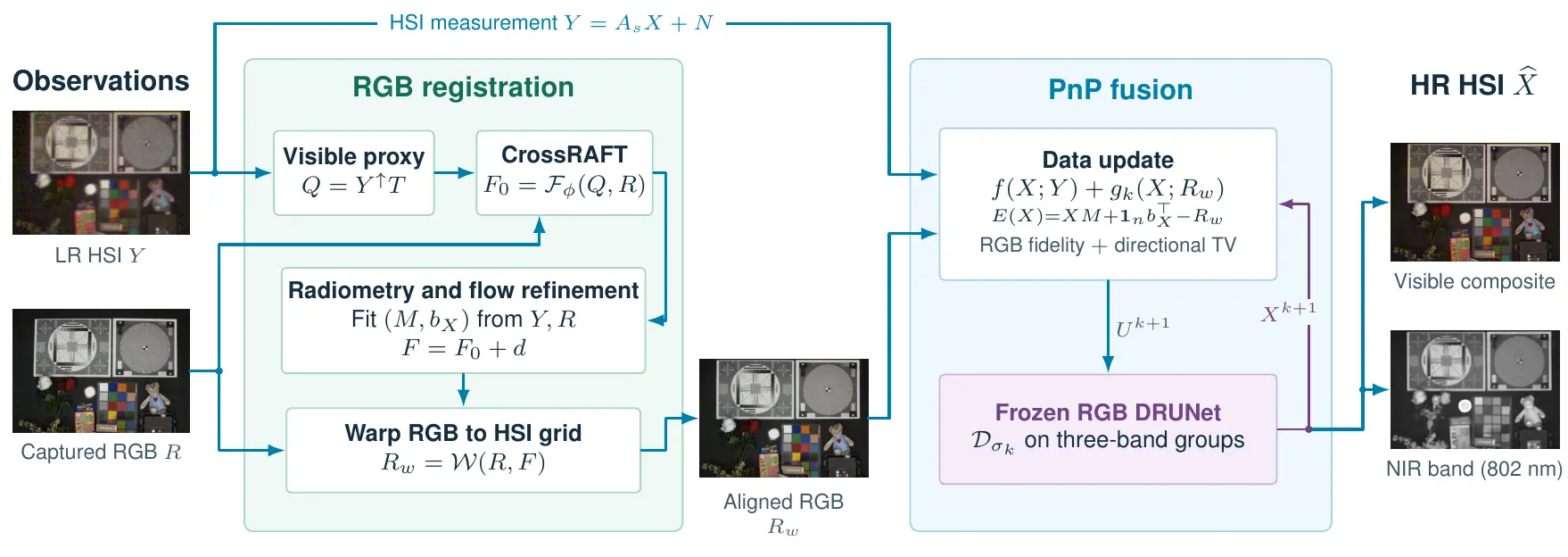
We introduce SHARPnP, an interpretable, flexible framework coupling registration and reconstruction for RGB-guided hyperspectral super-resolution from noisy, unaligned measurements without clean references. We adapt a pretrained registration model via a cross-view loss backpropagated through a fixed plug-and-play fusion module. Temporal and recorrupted pairs enable reference-free self-supervision on noisy inputs. At test time, we calibrate cross-camera radiometry and refine alignment. Plug-and-play fusion employs sequential three-band denoising.
On the REAL benchmark, SHARPnP outperforms supervised fusion baselines at 4x, 8x, and 16x on clean inputs and at 4x under Gaussian noise (sigma=5/255, 10/255). On native RGB-HSI snapshot measurements, it reconstructs all 51 VIS-NIR bands, beyond the conventional 31-band VIS setting, without high-resolution references.
Acknowledgements
This work was supported by the Institut Carnot Logiciels et Systèmes Intelligents (Carnot LSI) and by the French National Research Agency (ANR) under the France 2030 programme with reference ANR-23-IACL-0006. The computations were performed using the GRICAD infrastructure (GRANT CPER07_13 CIRA, ANR10 LABX56, ANR-10-EQPX-29-01).
Data acquisitions were carried out with the support of the Multi-camera Imaging Research and Acquisition (MIRA) Platform (https://mira-imaging.github.io/) of GIPSA-lab, which provided the camera setup and the acquisition and research resources used in this work. The MIRA Platform is developed with the financial support of the Institut Carnot Logiciels et Systèmes Intelligents (Carnot LSI).
The authors thank Dr. Amaury Negre for his contributions to the ROS-based acquisition software.